
Decidual Cast vs Miscarriage: Differences, Symptoms and Warning Signs
Few moments in a person’s reproductive life feel as disorienting as passing tissue and not knowing what it means. The cramps are fierce, the bleeding is heavier than usual, and something firm and unfamiliar comes out. Your mind jumps to the biggest possible question: was that a miscarriage?
The honest answer is that decidual cast vs miscarriage is one of the hardest comparisons to make by sight alone. Both can bring labor-like cramping, heavy bleeding, and tissue you can see. One involves the loss of a pregnancy. The other is the uterine lining leaving in a single piece, and it can happen with or without pregnancy. This article explains how clinicians separate the two, what each experience tends to feel like, which results change the picture, and which warning signs should send you to care right away.
Whatever you passed, and whatever you are feeling about it, you are welcome here. The information below is meant to be clear and calm, not clinical and cold.
In one paragraph: A miscarriage is the end of a pregnancy that began inside the uterus. A decidual cast is a shed piece of uterine lining. They can look nearly identical, which is why a pregnancy test, blood work, an ultrasound, and sometimes a pathology report are what actually tell them apart. A cast can also show up alongside an ectopic pregnancy, so tissue that “looks like” a cast should never be treated as the final answer on its own.
Two Very Different Events That Share a Silhouette
What a miscarriage is
A miscarriage, also called early pregnancy loss, is the loss of a pregnancy before the point where a baby could survive outside the womb. Most occur in the first trimester. It is far more common than people realize, affecting roughly one in ten known pregnancies, and some estimates run higher because many losses happen before a person knows they were pregnant. In most early cases, doctors cannot point to a specific reason, and it is almost never caused by something the pregnant person did.
Typical signs include vaginal bleeding that ranges from light brown spotting to heavy flow with clots, cramping or lower back pain, and sometimes the fading of pregnancy symptoms like nausea or breast tenderness. Some people have no symptoms and learn of the loss at a scan.
What a decidual cast is
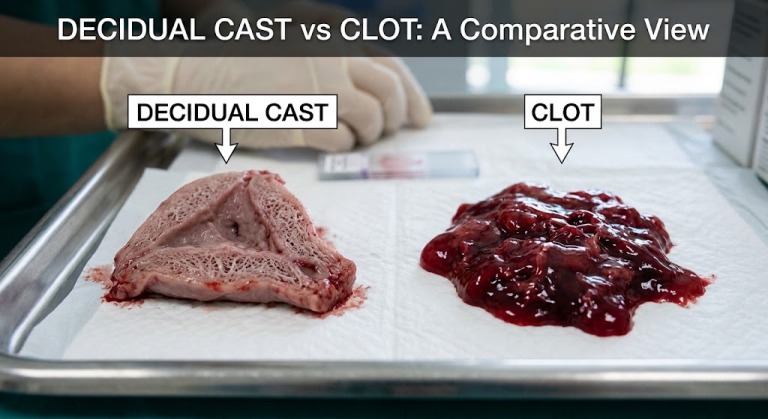
A decidual cast is the thickened uterine lining, called the decidua, shed all in one piece. The shape often echoes the uterine cavity, so it may be triangular, pear-like, or pouch-shaped. The medical term is membranous dysmenorrhea, and it is considered rare, with most knowledge coming from case reports and small reviews. A cast can occur without any pregnancy, particularly around changes in progesterone or hormonal contraception, but it can also accompany a pregnancy loss or an ectopic pregnancy.
If you want to see how clinicians describe the tissue itself, our guide to decidual cast images covers appearance in detail, and our explainer on what a decidual cast is gives the full background.
Five Questions That Sort It Out
Clinicians do not decide based on one clue. They run through a handful of questions, and you can mentally follow the same path, even though only testing can finish the job.
Decidual Cast vs Miscarriage at a Glance
| Feature | Decidual cast | Miscarriage |
|---|---|---|
| What it is | Shed uterine lining (decidua) | Loss of an early pregnancy |
| Pregnancy required? | No, but it can occur with one | Yes, by definition |
| Typical tissue | One firm, shaped piece, sometimes torn | Clots plus tissue, possibly a sac or fragments |
| Pregnancy test before the event | Often negative, but may be positive if linked to a pregnancy | Positive |
| Pregnancy test after | Negative if no pregnancy was involved | May stay positive for weeks as hCG falls |
| Pain pattern | Intense waves, often a sudden drop after passing | Cramping and bleeding that taper over hours to days |
| Bleeding | Heavy around the event, then lighter | Can be heavy, then lighter spotting that can last up to a few weeks |
| Common backdrops | Hormone changes, contraception, sometimes ectopic pregnancy | Often unexplained; chromosomal issues are the commonest cause |
| Confirming test | hCG, ultrasound, pathology showing lining without placental villi | hCG trend, ultrasound, pathology showing pregnancy tissue |
| Treatment | Usually none for the cast itself; review of triggers | Watchful waiting, medication, or a procedure |
| Emotional load | Shock, fear, confusion | Grief is common, whether or not the pregnancy was planned |
How Each One Tends to Unfold
The sequence of events can say as much as the tissue. The graphic below shows the typical rhythm of each, with the caveat that real life is messier than any diagram.
Why the “relief” clue is imperfect
Many people report immediate relief after a cast. That is a useful pattern, but it is not exclusive. Some miscarriages also bring a real drop in pain once the tissue passes, and some casts come with lingering soreness. Treat the timeline as supporting evidence, not proof.
When Both Happen Together
Here is the part many articles skip: the question is not always “cast or miscarriage.” Sometimes it is both, and sometimes it is a third thing.
A cast alongside an early pregnancy loss
When a pregnancy ends, the lining that supported it can shed along with the pregnancy tissue, sometimes intact. This is why a pathology exam is so useful, since it looks for the microscopic structures unique to pregnancy.
A cast alongside an ectopic pregnancy
In an ectopic pregnancy, the pregnancy grows outside the uterus, usually in a fallopian tube. Pregnancy hormones still thicken the uterine lining, and that lining can later pass as a cast. In that situation, passing tissue at home does not mean the pregnancy has ended, and an ectopic pregnancy can become dangerous if it ruptures. This is the reason clinicians insist on blood tests and imaging instead of accepting “I passed tissue” as proof of a completed loss.
Important: If you have a positive pregnancy test and you pass tissue, especially with one-sided pain, dizziness, or shoulder pain, seek urgent care. A cast-like piece can mask an ectopic pregnancy that still needs treatment.
Hormone levels that linger
The pregnancy hormone hCG does not vanish the instant a pregnancy ends. It declines over days to weeks. So a pregnancy test taken soon after passing tissue can still be positive after a true miscarriage, while a test after a cast that had nothing to do with pregnancy should be negative. This is why clinicians often repeat blood tests to watch the trend.
The Tests That Give Real Answers
When looks and symptoms are not enough, these steps cut through the uncertainty.
Pregnancy testing
A urine test is a quick first step. A blood test for hCG goes further, measuring the actual level. A single number helps, but a pair of numbers taken two days apart is often more informative, since the direction of change matters.
Transvaginal ultrasound
An ultrasound looks at the lining, checks for a pregnancy in or outside the uterus, and looks for retained tissue. Very early in pregnancy, a scan may not yet show anything, so doctors interpret it together with hormone levels.
Pathology
If you kept the tissue, a pathologist can examine it. Pregnancy tissue contains placental structures called chorionic villi. A cast from the lining alone contains decidua without them. This is often the closest thing to a definitive answer.
Blood type
If you are pregnant and bleeding, clinicians may check your Rh blood type, since some people need a preventive injection in certain situations. It is a routine part of care and nothing to worry about.
If you are not sure how to store or photograph what you passed, our guide on decidual cast vs blood clot includes practical tips for observation and saving a sample.
Four Illustrative Stories
These are composite examples, not real patients. They show how the same-looking event can mean different things.
Story one: the cast with a negative test
Nina has used a hormonal implant for three years. Her periods have been rare and light. One night she has overwhelming cramps, passes a pink, rubbery triangle, and the pain nearly vanishes. Her pregnancy test is negative at home and at the clinic, and an ultrasound looks normal. Her clinician explains that this fits a decidual cast and talks about whether her contraceptive plan still suits her.
Story two: a miscarriage that looked like a cast
Marcus and Elena had a positive test at six weeks. At seven weeks, Elena starts bleeding, then passes a gray-pink piece of tissue along with clots. The piece looks firm and shaped, so she wonders if it was a cast. Her hCG is falling on repeat testing and pathology later shows pregnancy tissue. It was a miscarriage. The shape fooled the eye, but the pregnancy history and the labs told the story.
Story three: the cast that came with a loss
Tasha has a miscarriage confirmed by ultrasound. Over the following day she passes a large, intact membrane-like piece. Her clinician explains that the uterine lining that supported the pregnancy can shed in one piece after a loss. In her case, a cast and a miscarriage coexisted.
Story four: the one that needed urgent care
Priya has a positive test, then spotting and a cast-like piece of tissue. She feels better for a day, then develops sharp pain on one side and lightheadedness. At the emergency department, an ultrasound shows no pregnancy in the uterus and blood work points to an ectopic pregnancy. Because she came in quickly, treatment could begin before serious complications set in. It is the clearest example of why “I passed something” is not the end of the evaluation.
If It Is a Miscarriage: Care Options
When a miscarriage is confirmed in the first trimester, there are usually three evidence-based paths, and medical organizations generally consider them comparable in safety. The right one depends on your health, how far along you were, and what feels right to you.
- Watchful waiting (expectant management). Your body passes the tissue on its own. This can take days to a few weeks, and bleeding and cramping can be significant. Follow-up checks confirm that everything has passed.
- Medication. Medicines such as misoprostol, sometimes together with mifepristone, help the uterus empty. Expect cramping and bleeding heavier than a period, usually most intense over a few hours to a day, with lighter bleeding for up to a few weeks.
- A short procedure. A clinician gently removes tissue from the uterus, often with local or general anesthesia. This can be chosen when bleeding is heavy, when tissue remains, or when you prefer a predictable timeline.
Whichever path you choose, ask what to expect, what is normal, and when to call. Retained tissue, infection, or heavy bleeding can occur, so follow-up matters.
If It Is a Decidual Cast: What Comes Next
When a cast is the answer and pregnancy-related causes are excluded, the plan is usually simple. The cast itself generally needs no treatment. Your clinician may review your contraceptive method, ask about your cycle, and discuss whether anything should change. Evidence suggests a cast on its own does not lead to lasting fertility problems, although research is limited because the condition is rare. Our guide to recovery after a decidual cast covers the practical side, and our overview of decidual cast causes explains what may have contributed.
Warning Signs That Should Not Wait
Get urgent or emergency care if you notice:
- Severe pain on one side of the lower belly, or pain in the tip of the shoulder
- Soaking a pad or tampon every hour for two hours or more
- Fainting, dizziness, a fast heartbeat, or cold, clammy, pale skin
- Fever, chills, or flu-like symptoms, or foul-smelling discharge
- Bleeding that lasts more than two weeks or keeps getting heavier
- Large clots with worsening pain after you thought it was over
- A positive pregnancy test with pain or bleeding
These can point to an ectopic pregnancy, retained tissue, heavy blood loss, or infection.
Looking After Your Mind
Even if what you passed turns out not to be a pregnancy, the shock of the experience is real. If it was a miscarriage, grief may arrive in waves, and it can look different for different people, including partners. There is no correct timeline.
A few gentle ideas that many people find helpful:
- Tell someone you trust. Isolation tends to magnify fear.
- Ask your clinician to walk you through it. Understanding what happened can ease the replaying in your head.
- Give yourself rest. Your body has been through a physical event, and fatigue is normal.
- Consider support. Counselors and pregnancy loss support groups exist because this is so common and so heavy.
- Be patient about trying again. Ask your clinician when it is medically safe, then decide when it feels emotionally right.
If sadness, anxiety, or intrusive thoughts feel overwhelming or last, reach out to your doctor or a mental health professional. You deserve care for how you feel, not just for what happened physically.
Myths Worth Retiring
- Myth: if it was shaped like a triangle, it was not a miscarriage. Pregnancy tissue and linings can both hold a shape. Shape alone settles nothing.
- Myth: a negative test after passing tissue proves there was no pregnancy. Timing, test sensitivity, and ectopic pregnancy complicate this, so clinical follow-up still matters.
- Myth: a decidual cast is a hidden miscarriage. A cast on its own is not a pregnancy loss.
- Myth: miscarriage is caused by stress, exercise, or lifting something. Everyday activity does not cause early pregnancy loss.
- Myth: you must have done something to cause either one. You almost certainly did not.
Questions People Ask About Decidual Cast vs Miscarriage
Can a decidual cast be mistaken for a miscarriage?
Yes, easily. Both can involve cramping, heavy bleeding, and passing tissue. Pregnancy testing, ultrasound, and sometimes pathology are what tell them apart.
Is a decidual cast a type of miscarriage?
No. A cast is shed uterine lining. A miscarriage is the loss of a pregnancy. They can occur together, but they are not the same thing.
Can you have a decidual cast without being pregnant?
Yes. It can happen around hormonal changes with no pregnancy at all, though pregnancy has to be ruled out.
Will a pregnancy test be positive after a decidual cast?
If no pregnancy was involved, it should be negative. If a pregnancy was involved, the hormone can stay detectable for a while.
How can a doctor tell the difference?
By combining your history, blood hormone levels, an ultrasound, and, if you saved the tissue, a pathology exam that looks for placental structures.
Should I keep the tissue?
If it is safe and you feel able to, place it in a clean container and bring it, plus photos, to your appointment. If that feels like too much, that is understandable, and you can still be evaluated.
Can a decidual cast be a sign of ectopic pregnancy?
It can accompany one. That is why a positive pregnancy test with tissue passing, one-sided pain, or dizziness needs urgent medical attention.
Does a decidual cast or a miscarriage affect future pregnancies?
A decidual cast alone has not been linked to lasting fertility problems. Most people who have a single miscarriage go on to have healthy pregnancies, but talk with your clinician about your own history.
How long does bleeding last after each?
After a cast, bleeding often settles within days. After a miscarriage, light bleeding can continue up to a few weeks. Bleeding that is heavy, getting worse, or lasting beyond two weeks should be checked.
Key Takeaways
- A decidual cast is shed uterine lining, while a miscarriage is the loss of an early pregnancy. They can look the same and sometimes occur together.
- Appearance and pain patterns offer clues, but hCG tests, ultrasound, and pathology provide answers.
- A cast can accompany an ectopic pregnancy, so any positive test plus tissue and pain needs prompt care.
- Miscarriage care includes waiting, medication, or a procedure, and each is a valid choice.
- Your emotional response deserves as much attention as the physical one.
To keep learning, explore the rest of the decidual cast resource library for more guides written in plain language.
Medical note: This article is for general education and does not replace care from a licensed healthcare professional. If you have passed tissue, are bleeding, are in pain, or think you may be pregnant, contact a clinician promptly, and seek emergency care for any warning sign listed above.
Sources consulted for fact-checking: Cleveland Clinic patient education on decidual cast; Healthline and Medical News Today overviews of decidual casts; the 2026 scoping review “Membranous dysmenorrhea and decidual casts” (via PubMed Central); TODAY.com interviews with OB-GYNs; patient guidance on early miscarriage management from health systems and the NHS; the ACOG early pregnancy loss practice bulletin as summarized by clinician education resources.