
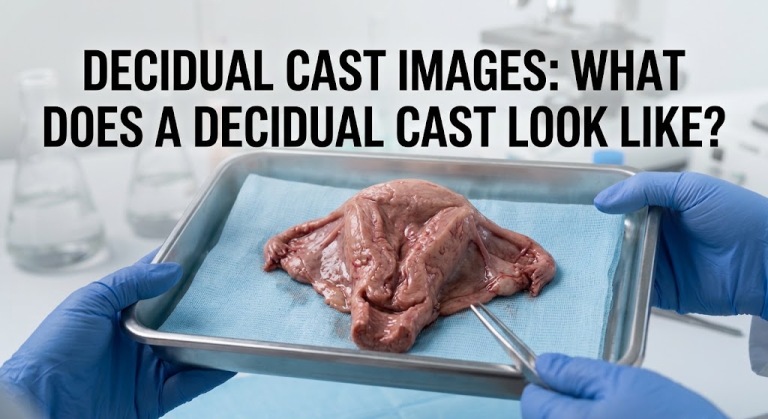
Decidual Cast Images: What Does a Decidual Cast Look Like?
You are probably here because something unusual just came out of your body, and your first instinct was to pick up your phone and search for decidual cast images. That is a completely understandable reaction. Passing a firm, fleshy, sometimes triangular piece of tissue during what felt like a brutal period is startling, and a photo comparison feels like the quickest way to get answers.
This guide is built to give you those answers without the shock value. Below you will find a clear, word-by-word description of what a decidual cast looks like, two illustrated diagrams that show its typical shape and features, a comparison of the things it is most often confused with, and a plain-language explanation of why it happens and when you should get medical help. If you only have a minute, start with the quick answer right below.
Quick answer: A decidual cast is a single, soft, rubbery piece of tissue, usually pink, red, or grayish-pink, that often mirrors the triangular shape of the uterine cavity. It can be as small as a thumbnail or as large as the palm of a hand, and it may be intact or torn into a few pieces. It is made of the uterine lining (the decidua), not a pregnancy. It is rare and often harmless, but because it looks so similar to pregnancy tissue, a clinician should always check it, and an ectopic pregnancy must be ruled out.
What a Decidual Cast Actually Is
To make sense of any picture, it helps to know what you are looking at. Each cycle, the inner layer of the uterus (the endometrium) thickens in preparation for a possible pregnancy. When pregnancy hormones are present, or when high levels of progesterone mimic them, that thickened layer transforms into a specialized tissue called the decidua. In a typical period, this lining crumbles away in small fragments and mixes with blood, which is why most menstrual flow looks like liquid with a few soft clots.
A decidual cast happens when that lining lets go as one organized sheet instead of crumbling. Because the uterine cavity is roughly triangular, the sheet often keeps a similar outline, like a soft mold of the inside of the uterus. That is where the word “cast” comes from.
The medical name is membranous dysmenorrhea, which literally means painful menstruation involving a membrane. It is considered rare, and most of what is known comes from individual case reports and a small number of reviews rather than large studies. A 2026 scoping review of the English-language literature described both membranous dysmenorrhea and decidual cast expulsion as benign phenomena that can lead to diagnostic confusion and sometimes unnecessary procedures. In other words, the tissue itself is usually not dangerous, but misreading it can be.
If you want the full clinical background beyond pictures, our guide to what a decidual cast is covers the biology in more depth.
What a Decidual Cast Looks Like, Feature by Feature
Photos vary with lighting, camera quality, and how much blood is still on the tissue, so a written checklist is often more reliable than any single picture. Here is how people and clinicians typically describe it.
Color
Most casts are pink, salmon, deep red, or a grayish-pink. Fresh tissue tends to look redder because it is saturated with blood. After it sits in water or on a white surface for a while, the color often fades to a paler, more translucent pink or off-white. Some descriptions mention a slightly yellowish or tan edge, particularly on thinner portions.
Shape
The classic shape is a rough triangle or pear, sometimes with a small tail at one corner where the lining extended toward a fallopian tube opening. Not every cast holds that shape. If it tore on the way out, you may see a folded, crumpled, or ribbon-like piece that only hints at a triangle.
Texture
Texture is the biggest giveaway. A decidual cast feels soft, smooth, and a little rubbery, sometimes compared to a wet piece of skin or a thin slice of cooked liver. Ordinary menstrual clots are jelly-like and fall apart when pressed. A cast generally holds together when you move it gently.
Thickness and surfaces
Many casts are thin to moderately thick, and the two sides often look different. The side that faced the uterine wall may look rougher or more shaggy, while the side facing the inside of the cavity is smoother. Some have small holes or pockets where the surface stretched. If you slowly lift a cast in a bowl of water, it may unfold like a tiny, flattened pouch.
Size
Reported sizes range widely, from a fingertip-sized fragment to something close to the full length of the uterine cavity, often described as roughly palm-sized. Size depends on how thick your lining was and whether the tissue came out whole or in pieces.
Quick appearance checklist
| Feature | Typical decidual cast | Ordinary menstrual clot |
|---|---|---|
| Shape | Triangular, pear-like, or a folded sheet | Irregular blob or strands |
| Texture | Firm, rubbery, holds together | Soft, jelly-like, crumbles |
| Color | Pink, red, grayish-pink, sometimes pale when rinsed | Dark red to nearly black |
| Size | Often several centimeters, up to palm-sized | Usually smaller than a coin to a few centimeters |
| Behavior in water | May open into a hollow pouch or sheet | Disperses into strings and cloudy blood |
| Pain pattern | Intense cramps that ease sharply once passed | Usual period cramps, gradual |
How to Read Decidual Cast Images Online (and Where They Mislead)
Searching for decidual cast images can be oddly unhelpful. Many results are reposted screenshots with no source, stock photos mixed in with forum snapshots, or pages that scrape the same few images over and over. Here is how to get real value from what you find.
- Prioritize labeled sources. Images attached to clinical case reports, hospital health pages, or reputable medical publishers are far more reliable than anonymous reposts. A label stating that the tissue was confirmed by pathology means something. A caption reading “my cast!!” does not.
- Remember that lighting changes everything. A cast photographed on a white sink under bright bathroom light looks different from the same tissue on a dark towel. Compare shape and texture rather than exact color.
- Be wary of look-alike photos. Photographs of miscarriage tissue, retained products of conception, ovarian cyst contents, or even non-human tissue circulate under the “decidual cast” label. Online image sets are not curated for accuracy.
- Know that a photo cannot confirm the cause. Decidual tissue from a hormonal cast and decidual tissue from an early pregnancy loss can look nearly identical to the naked eye. Only testing, and sometimes microscopic examination, separates them.
- Protect your emotional state. Some images are graphic. If you are in pain, worried about a pregnancy, or grieving, it is fine to skip the photos and go straight to the written descriptions above.
The honest limit of pictures: A decidual cast image can tell you whether your tissue is consistent with a cast. It cannot tell you whether you were pregnant, whether the pregnancy was in the right place, or whether anything is left behind in the uterus. That is why a lab test or ultrasound beats any comparison photo.
Look-Alikes: What Else Could That Tissue Be?
One reason decidual cast images cause so much anxiety is that several different things can resemble each other. Sorting through them is a clinician’s job, but knowing the possibilities helps you ask better questions.
| What it might be | How it often looks | Key clue |
|---|---|---|
| Decidual cast | Triangular or sheet-like, pink to red, rubbery | Sudden pain relief after passing; no pregnancy tissue on testing |
| Large menstrual clot | Dark, jelly-like, falls apart | Squishes and disperses easily |
| Early miscarriage tissue | Clots plus grayish tissue, sometimes a small sac | Positive pregnancy test beforehand; sac or villi on pathology |
| Ectopic pregnancy tissue | May include a decidual cast with no visible sac | Positive hCG with one-sided pain; needs urgent evaluation |
| Retained products of conception | Fragments after a pregnancy loss or procedure | Ongoing bleeding, fever, or foul-smelling discharge |
| Prolapsing fibroid or polyp | Firm, rounded, attached mass | Recurring heavy periods; seen on ultrasound or exam |
| Vaginal skin or tampon fiber | Thin shreds, fuzzy strands | Mostly fibrous, rarely sheet-shaped |
Because the overlap is real, our comparison of a decidual cast versus a miscarriage walks through the differences in more detail, and our guide on decidual cast versus blood clot may help if your tissue seemed more jelly-like than firm.
Three Illustrative Scenarios
The stories below are composites, written to show how this event tends to unfold. They are not real patient records, and your experience may differ.
Scenario one: the unexpected period
Maya, in her late twenties, has used a progestin-only pill for two years. Her periods have been light and irregular. One morning she wakes with the worst cramps of her life, rolling waves that make it hard to stand. After about an hour she goes to the bathroom and passes a pinkish, triangular piece of tissue about the length of her thumb. The pain drops almost instantly. She photographs it, rinses it gently, and calls her gynecologist. A pregnancy test is negative, an ultrasound shows a normal uterus, and her clinician concludes it was a decidual cast linked to her hormone pattern. They talk about whether to change her pill.
Scenario two: late period with a surprise
Jordan is two weeks late, has had one positive home test, and then starts bleeding with sharp cramping. Tissue passes that looks similar to the photos online. Jordan assumes it is just a miscarriage. A blood test shows a hormone level that does not behave the way it should after a completed loss, and an ultrasound finds no pregnancy inside the uterus. This is exactly the situation clinicians worry about: a decidual cast can form in the uterus alongside an ectopic pregnancy. Because Jordan was evaluated early, treatment began before any rupture risk grew.
Scenario three: after stopping birth control
Priya stops using a hormonal contraceptive after several years. Two months later she has a heavy, painful period and passes a thick, rubbery sheet with a gray tint. She is not pregnant, has no concerning symptoms afterward, and her next cycles are regular. Her doctor explains that hormonal shifts around starting or stopping contraception are among the situations in which casts are reported, and that no specific treatment is needed once it has passed.
The common thread in all three: the tissue looked similar, but the meaning was different. That is why evaluation matters more than appearance.
Why Does a Decidual Cast Happen?
Clinicians do not fully agree on a single cause, and many cases are never explained. The leading explanations point to hormones acting on the uterine lining.
- Progesterone shifts. Progesterone drives the lining to thicken and become decidual. When progesterone levels drop suddenly, the thickened tissue can release in one go rather than breaking apart gradually.
- Hormonal contraception. Case reports repeatedly mention pills, injections, implants, or hormonal IUDs, and sometimes the weeks after stopping them. Reports exist across many methods, so it is not tied to one brand or type.
- Ectopic pregnancy. A pregnancy implanted outside the uterus produces pregnancy hormones that change the uterine lining. When the lining sheds, it can appear as a cast. This is the cause that makes a medical check non-negotiable.
- Early pregnancy loss. A miscarriage can release decidual tissue intact. Pathology looks for the microscopic signs that separate a pregnancy-related loss from a non-pregnant cast.
- Fertility medications or hormone therapy. Treatments that boost progesterone or estrogen can change how the lining builds and sheds.
- Unknown triggers. A portion of cases happen to people with no hormone use, no pregnancy, and no identifiable cause.
It is worth saying clearly: passing a cast does not mean you did something wrong. It is not caused by diet, exercise, stress, or a tampon, and it is not contagious or hereditary in any known way.
For a deeper look at the contributing factors, see our breakdown of decidual cast causes and risk factors.
The Symptoms That Come With It
The tissue is often the last chapter of a story that started hours or days earlier. Many people describe a pattern like this:
- Build-up. Spotting, a delayed period, or heavier-than-usual bleeding for a few days.
- Escalating pain. Cramps that feel rhythmic and labor-like, often centered low in the abdomen and sometimes radiating to the back or thighs.
- Release. A sensation of pressure or something moving down, followed by the passage of tissue, sometimes with a gush of blood.
- Relief. Pain that fades rapidly, often within minutes to hours. Bleeding may continue lightly for several days.
Other reported symptoms include nausea, lightheadedness, and a general wrung-out feeling afterward. Persistent or worsening pain after the tissue passes is not typical and deserves a call to a clinician.
What To Do With the Tissue and Your Photos
If you have just passed something and you are unsure what it is, a few calm steps will make your appointment much more productive.
- Do not flush it. If you can, keep it. A clinic or lab can examine it, and that is often the only way to know for sure what it was.
- Use clean gloves or a clean spoon. Place it in a clean container with a lid, ideally with a little saline or clean water. Some clinics prefer it refrigerated, not frozen. Ask when you call.
- Take photos first. Photograph it against a plain light background, once flat and once with something for scale, such as a coin or a ruler. Use natural light, avoid heavy filters, and note the date and time.
- Jot down the details. Write down when pain began, when the tissue passed, how much you bled, whether you have taken a pregnancy test, and any hormonal medication you use.
- Wash your hands well afterward. It is normal to feel shaky or upset. Have someone nearby if you can.
Your own photograph, along with a short timeline, is usually more useful to your doctor than any decidual cast images you find online, because it shows your tissue in your context.
How Doctors Confirm a Decidual Cast
There is no single test labeled “decidual cast,” so confirmation is a process of ruling things out and, when possible, examining the tissue itself.
History and exam
Expect questions about your cycle, contraception, recent pregnancy tests, pain, and bleeding. A pelvic exam checks the cervix and uterus.
Pregnancy testing and hormone levels
A urine test is the first step. A blood test measuring hCG, sometimes repeated over a couple of days, shows whether a pregnancy hormone is present and how it is changing. This is central to ruling out an ectopic pregnancy.
Ultrasound
A transvaginal ultrasound looks at the uterine lining, checks for a pregnancy in the uterus or elsewhere, and looks for retained tissue.
Pathology
If you saved the tissue, a pathologist can look at it under a microscope. A cast from a non-pregnant uterus shows decidual tissue without the specific placental structures (chorionic villi) that signal a pregnancy.
Talking about all of this can feel exposing. If embarrassment is stopping you from calling, know that clinicians see unusual tissue regularly, and surveys suggest many people never seek care for a cast out of discomfort, which is exactly how ectopic pregnancies get missed.
Warning Signs That Need Urgent Care
Seek emergency care right away if you have any of the following:
- Severe pain focused on one side of the lower abdomen
- Pain in the shoulder tip, or pain with a feeling of faintness
- Soaking through a pad every hour for two hours or more
- Dizziness, fainting, a racing heartbeat, or pale, clammy skin
- Fever or chills, or foul-smelling vaginal discharge
- A positive pregnancy test combined with any pain or bleeding
These can signal a ruptured ectopic pregnancy, heavy hemorrhage, or infection. Do not wait for a scheduled appointment.
Even if none of those apply, call your clinician the same day or within a day or two if you passed tissue and you are not sure why. An early evaluation is far easier than a late one.
Recovery, Fertility, and Recurrence
Is treatment needed?
For a cast on its own, no specific treatment is usually required once it has passed and other causes are excluded. Management focuses on comfort and on addressing whatever may have triggered it. If a hormonal contraceptive seems to be involved, your clinician may discuss whether to continue it, adjust it, or switch methods. Do not stop or change a prescription on your own without guidance.
Managing pain and bleeding
Over-the-counter pain relievers and heat can help with leftover cramping, provided they are safe for you. Follow your clinician’s advice, especially if you could be pregnant. Light bleeding or spotting for a few days is common afterward.
Will it affect fertility?
Current evidence suggests that a decidual cast, by itself, is not linked to lasting fertility problems. The underlying cause matters more. If it came with an ectopic pregnancy or a pregnancy loss, that is what your care team will focus on.
Can it happen again?
Recurrence appears uncommon, but because the condition is so rarely studied, firm numbers are lacking. If you pass another cast, mention it to your clinician so patterns, such as medication timing, can be looked at.
Emotional recovery
Whether your cast was a medical curiosity or part of a pregnancy loss, the experience can leave you shaken, confused, or sad. It is normal to replay it. Talking with a trusted friend, counselor, or support group can help, and so can simply asking your doctor to walk you through what happened.
For more on what to expect in the days following, see our guide to recovery after a decidual cast.
Common Myths About Decidual Casts
- Myth: it always means you were pregnant. Not so. Casts can occur without any pregnancy, though pregnancy must be checked.
- Myth: it is a sign of cancer. There is no established link between a decidual cast and cancer.
- Myth: it is a failed attempt to conceive. A cast is a lining event, not a lost embryo, unless testing shows otherwise.
- Myth: nothing is required afterward. The tissue may need no treatment, but the evaluation still does.
- Myth: if a photo looks the same, it is the same. Visual similarity is exactly the problem; it does not prove cause.
Frequently Asked Questions About Decidual Cast Images
What does a decidual cast look like?
It typically looks like a soft, rubbery, pink-to-red piece of tissue, often triangular because it mirrors the inside of the uterus. It may be whole or in a few pieces, and it tends to hold together instead of crumbling like a clot.
Where can I find reliable decidual cast images?
Look to clinical case reports, hospital or university health pages, and medical review articles, where tissue is labeled and confirmed. Treat anonymous social media or forum posts with caution, since they cannot be verified.
How big is a decidual cast?
Anywhere from a thumbnail-sized fragment to roughly palm-sized. Size relates to how thick the lining was and whether it came out in one piece.
Is a decidual cast the same as a miscarriage?
No. A cast is shed uterine lining, while a miscarriage is the loss of a pregnancy. They can look and feel alike, which is why a pregnancy test and clinical evaluation matter.
Can I tell a decidual cast from a blood clot by sight?
Often, yes, in a rough way: casts are firm, organized, and shaped, while clots are dark and jelly-like. But borderline cases are common, so do not rely on sight alone.
Does a decidual cast hurt?
Many people report intense, labor-like cramping beforehand, with rapid relief once the tissue passes. Pain that continues or worsens afterward should be checked.
Should I keep the tissue?
If you can do so safely, yes. Put it in a clean container and bring it, plus photos, to your clinician. Pathology can give a more definite answer than appearance can.
Can a decidual cast happen without being pregnant?
Yes. Reports exist in people who were not pregnant, especially around hormone changes. Still, pregnancy and ectopic pregnancy have to be ruled out first.
Will it come back?
Repeat events seem uncommon, but good data is limited. Keep your clinician informed if it happens again.
Key Takeaways
- Decidual cast images show a soft, pink-to-red, often triangular piece of uterine lining that holds together.
- Pictures can suggest a cast, but only testing, ultrasound, and sometimes pathology can confirm it.
- It is rare, usually harmless, and tends to be followed by quick pain relief.
- Because ectopic pregnancy can look the same, medical evaluation should never be skipped.
- Photograph and, if possible, save the tissue; your own photo and timeline help more than any online image.
If you would like to keep learning, browse the rest of our decidual cast library for in-depth guides on symptoms, diagnosis, and recovery.
Medical note: This article is for general education and does not replace advice from a licensed healthcare professional. If you have passed tissue, are in pain, or think you could be pregnant, contact a clinician promptly, and seek emergency care for any of the warning signs listed above.
Sources consulted for fact-checking: Cleveland Clinic patient education on decidual cast; Healthline and Medical News Today overviews of membranous dysmenorrhea; the 2026 scoping review “Membranous dysmenorrhea and decidual casts” (International Journal of Gynecology & Obstetrics, via PubMed Central); TODAY.com interviews with OB-GYNs on decidual casts.

2 Comments