Decidual Cast vs Blood Clot: How Are They Different?
It is the middle of a heavy period, you head to the bathroom, and something is in the toilet or on the pad that does not look like anything you have seen before. It is big, it holds together, and your first thought is probably some version of “is that a clot?” The truth is that the decidual cast vs clot question trips up plenty of people, and sometimes even clinicians need a lab to settle it.
This guide walks you through the difference in plain language. You will learn what each one is made of, why they form, how to compare size, color, texture, and pain, what a few simple observations can and cannot tell you, and exactly which symptoms mean you should not wait for an appointment. There are also worked examples and a decision diagram to make the comparison easier to remember.
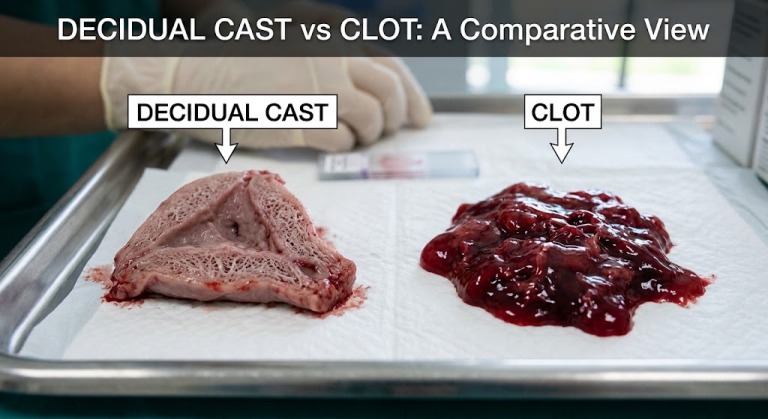
The short version: A menstrual clot is jelly-like coagulated blood with a little tissue mixed in. It is usually dark red, squishy, and falls apart when pressed. A decidual cast is a firm, rubbery piece of uterine lining that often keeps a triangular or pouch-like shape. Clots are common and are mostly a sign of heavy flow. Decidual casts are rare, tend to arrive with intense cramping that suddenly eases, and always deserve a medical conversation because they can look like pregnancy tissue.
The Two Things Being Compared
What a menstrual clot is
Period blood is not just blood. It is a blend of blood cells, bits of shed uterine lining, mucus, and proteins that help control clotting. The uterus releases natural anticoagulants that keep the flow liquid so it can drain easily. When the flow is heavy or slow, those anticoagulants cannot keep pace, and some of the blood thickens into soft clumps before leaving the body.
These menstrual clots are not the same thing as the dangerous clots that can form in leg veins or arteries. Different process, different location, different risks. A period clot is simply blood that gelled while waiting its turn to leave.
What a decidual cast is
A decidual cast is the uterine lining itself, shed in one organized piece rather than crumbling away gradually. The lining in question is called the decidua, a thickened tissue that builds up under the influence of progesterone or pregnancy hormones. When it detaches all at once, it tends to keep the outline of the uterine cavity, which is why people describe it as triangular, pear-shaped, or like a little pouch.
The clinical term is membranous dysmenorrhea. It is considered rare, and what we know comes largely from case reports and small reviews. If you want the full background, our overview of what a decidual cast is goes deeper, and our visual guide to decidual cast images shows how the tissue is typically described.
Decidual Cast vs Clot, Side by Side
Here are the two compared along the characteristics people notice first.
Menstrual clot
- Gelatinous, like thick jam
- Dark red, maroon, or bright red
- Irregular blob or strand
- Squishes and breaks apart
- Usually under an inch across
- Comes with ordinary period cramps
Decidual cast
- Rubbery, like a damp piece of skin
- Pink, salmon, gray-pink, or red
- Triangular, pear-like, or pouch-like
- Holds together when handled gently
- Often larger, from a thumbnail to a palm
- Comes with severe, wave-like cramping
| Trait | Menstrual clot | Decidual cast |
|---|---|---|
| What it is made of | Coagulated blood, some tissue, clotting proteins | Intact uterine lining (decidua), plus mucus and blood |
| How common | Very common, especially on heavy days | Rare |
| Consistency | Soft, jelly-like, falls apart | Firm, rubbery, stays in one piece |
| Surface | Glossy and uniform | Two different sides: smoother inside, rougher outside |
| Shape | Random | Often a triangle or hollow pouch |
| Typical size | Smaller than a quarter to a little larger | Several centimeters, sometimes palm-sized |
| Timing | Heavy-flow days | Around an expected or delayed period, or after hormone changes |
| Pain after passing | No sudden change | Often sharp relief within minutes to hours |
| Link to hormones | Mostly flow volume and speed | Progesterone shifts, hormonal contraception, sometimes pregnancy |
| Need for a check | When large, frequent, or with heavy bleeding | Almost always, to exclude pregnancy-related causes |
Careful Observations You Can Make at Home
No home method can replace a clinician, but a few calm observations can help you describe what you saw and decide how quickly to call. If you are alone and shaky, skip anything that feels like too much and rely on photos.
1. Photograph it first
Before touching it, take a clear photo on a plain light surface, with a coin beside it for scale. Good lighting matters because colors shift under yellow bathroom bulbs. Your own photo is something you can show a doctor later.
2. Look at the shape
Ask yourself whether the shape looks like a random lump or a deliberate outline. Triangles, pears, and hollow pouches point toward a cast. A formless blob points toward a clot.
3. Notice how it behaves when moved
If you gently lift it with clean gloves or a spoon, a clot tends to slump, smear, or split. A cast usually keeps its structure, even if it is folded.
4. Try the gentle water look
Some people place the tissue in a clean container of water. A clot often clouds the water and breaks into strands. A cast may float or hover, unfolding into a thin sheet or pocket. Treat this as a rough clue rather than proof, since a thick clot and a crumpled cast can fool anyone.
5. Check the color pattern
Clots are mostly uniform dark red. Casts are often paler pink with some darker blood on the surface, because the tissue is mostly lining rather than blood.
6. Think about the pain curve
With a clot, cramps tend to continue and fluctuate through the period. With a cast, pain often builds into rolling, labor-like waves and then drops off quickly after it passes.
What home checks cannot do: They cannot tell you whether the tissue is connected to a pregnancy, including one outside the uterus. A decidual cast, a miscarriage, and an ectopic pregnancy can look almost the same to the eye. That is why a pregnancy test and a medical review matter even when the tissue “looks like” a cast.
A Simple Decision Diagram
This chart is a thinking tool, not a diagnosis. It shows the path most clinicians follow mentally: look, think about pregnancy, and then think about bleeding volume.
Why Clots Form, and When They Stop Being Normal
Clots are the more familiar side of this comparison, so it is worth understanding them properly. When your flow is moderate, the uterus’s natural anticoagulants keep blood liquid. On the heaviest days, blood arrives faster than those substances can process, and some of it pools and thickens. Slow drainage, for example when you are lying down for hours, can encourage this too.
The quarter rule
Medical sources commonly use the size of a US quarter, roughly an inch or 2.5 centimeters across, as a handy line. Small, occasional clots under that size on heavy days are usually considered normal. Clots larger than a quarter, especially if they happen repeatedly, are worth discussing with a clinician.
Signs your flow is genuinely heavy
- Soaking through a pad or tampon in about two hours or less, for several hours in a row
- Needing to change protection overnight
- Periods lasting longer than seven days
- Feeling tired, dizzy, or short of breath, which can signal low iron
Common reasons for heavy clotting
Fibroids, polyps, adenomyosis, endometriosis, hormonal imbalances, some intrauterine devices, bleeding disorders such as von Willebrand disease, and the period after pregnancy can all increase bleeding and clotting. This is one reason a large clot should not simply be dismissed. If you notice a pattern, see our guide to decidual cast causes and risk factors for how the hormonal side overlaps with heavy bleeding.
Why a Cast Forms
The exact trigger is often unclear, which is part of why this topic confuses people. The main explanations include:
- Progesterone changes. The lining thickens under progesterone and can release as a single sheet when levels drop quickly.
- Hormonal contraception. Case reports describe casts in people using pills, injections, implants, and hormonal IUDs, and around the time of starting or stopping them.
- Ectopic pregnancy. A pregnancy outside the uterus can change the uterine lining, which may later pass as a cast. This is the most important possibility to rule out.
- Pregnancy loss. Early loss can include decidual tissue that comes out intact.
- No identifiable reason. Some cases appear in people with no hormones, no pregnancy, and no explanation.
Because the underlying causes range from harmless to urgent, passing a cast should lead to a conversation, not just a shrug.
How the Pain Compares
Pain gives away more than most people expect.
With a clot, the pain generally follows the same pattern as your usual period. It may be heavier than normal, but it does not usually stop abruptly. Passing a clot can bring a brief sensation of release, but the cramps typically continue.
With a cast, people describe wave after wave of strong, rhythmic, labor-like cramps, sometimes for hours, often centered low in the belly and radiating to the back or thighs. Then, once the tissue passes, the pain can drop dramatically. That abrupt change is one of the most consistent clues in case descriptions.
A warning: if the pain is on one side, sharp, or paired with dizziness or shoulder pain, that is not the usual cast pattern and needs urgent evaluation.
Four Worked Examples
These composite scenarios are illustrations, not real patient records. They show how similar-looking events can have different meanings.
Example 1: the heavy-day clot
Alicia has always had heavy first days. On day two she passes several dark red, jelly-like clots, the biggest about the size of a nickel. They squish when she touches them, her cramps feel like her usual period, and the flow lightens by day four. This looks like ordinary heavy-flow clotting. If it got worse or she soaked pads every hour, she would call her doctor.
Example 2: the surprise triangle
Dana, who recently stopped hormonal birth control, has crushing cramps for most of an evening. She then passes a pink, rubbery, triangular piece of tissue about the length of her thumb, and the pain stops almost immediately. She photographs it, keeps it in a clean container, and calls her gynecologist the next morning. A negative pregnancy test and a normal ultrasound support a decidual cast.
Example 3: the “clot” that was not
Sam assumes a large mass during a late period is a clot, because it came out in a gush of blood. But it feels fleshy and firm, and Sam had a faint positive home test last week. A clinician checks hCG levels and orders an ultrasound. The tissue turns out to be linked to an early pregnancy loss. Visual guessing would have missed the pregnancy context.
Example 4: the red flag
Leah passes tissue that looks like a cast, but she also has sharp pain on her right side and feels lightheaded. She goes to the emergency department. Tests show an ectopic pregnancy that needs prompt treatment. A cast can accompany this situation, which is exactly why the symptoms around the tissue matter as much as the tissue itself.
When It Is Neither One
Not every unusual lump fits neatly into “clot” or “cast.” Other possibilities include:
- Miscarriage tissue or retained pregnancy tissue. Often involves a positive pregnancy test beforehand, and sometimes a visible sac. See our comparison of decidual cast vs miscarriage.
- A prolapsing fibroid or polyp. Firm, rounded, and often tied to repeated heavy periods.
- Shredded lining that is simply thick. Heavy periods can produce stringy, tissue-like fragments that are not true casts.
- Foreign material. Tampon fibers, a tampon that was left in too long, or a fragment from a device.
- Infection-related discharge. Typically has a strong odor and may come with fever.
What the Doctor Will Do
A visit usually follows a predictable sequence:
- History. Your cycle, contraception, recent pregnancy tests, and exactly how the tissue passed.
- Pregnancy tests. A urine test, then often a blood test for hCG, sometimes repeated.
- Ultrasound. Looking at the uterine lining and checking for a pregnancy in or outside the uterus.
- Pathology, if you saved the tissue. A pathologist can tell decidual tissue from blood clot, and can look for the pregnancy structures that would change the diagnosis.
- Bleeding workup if clots are the main issue. Blood count, iron studies, and sometimes tests for clotting disorders.
If you can, bring the photo, the tissue in a clean container, and notes on timing. Do not feel embarrassed. Clinicians would much rather see the tissue than guess.
Signs That Mean Go Now
Get urgent or emergency care for any of these, whatever the tissue looked like:
- Pain focused on one side of the lower belly, or pain in the shoulder tip
- Soaking a pad or tampon every hour for two hours or more
- Fainting, dizziness, a racing heart, or very pale, clammy skin
- Fever, chills, or foul-smelling discharge
- A positive pregnancy test with pain or bleeding
These signs can indicate an ectopic pregnancy, major blood loss, or infection.
What Happens Afterward
If it was a clot
The focus shifts to why your flow is heavy. Treatment depends on the cause and may include iron support, hormonal options, medication to reduce bleeding, or procedures for fibroids or polyps. Keeping a simple diary of flow, clot size, and symptoms makes the diagnosis faster.
If it was a decidual cast
The cast itself generally does not need treatment once it has passed and other causes are excluded. Your clinician may review your contraceptive method and talk through whether anything should change. Evidence so far does not link a cast on its own to lasting fertility problems, though data is limited. Our guide to recovery after a decidual cast covers the days and weeks that follow.
If it was something else
Then the plan follows that diagnosis, which is why testing beats assumption.
Common Questions About Decidual Cast vs Clot
What is the main difference between a decidual cast and a clot?
A clot is thickened blood, soft and jelly-like. A decidual cast is a firm, intact piece of uterine lining that often keeps a triangular shape. Cramping that suddenly eases is more typical of a cast.
Can a decidual cast be mistaken for a clot?
Yes, especially when it is crumpled or covered in blood. Many people first assume they passed an unusually large clot until the firmer texture or shape draws attention.
How big is too big for a period clot?
A common guideline is larger than a quarter, about an inch across, especially if it happens often or alongside very heavy bleeding. That is a reason to see a clinician.
Is a decidual cast dangerous?
The cast itself usually is not, but the situation around it can be. Ectopic pregnancy must be ruled out, so a medical review is important.
Can I tell the difference at home?
You can gather clues, such as shape, firmness, and pain pattern, but only testing and sometimes pathology can confirm what it was.
Should I keep the tissue?
If it is safe to do so, yes. Put it in a clean container and bring it with photos to your clinician.
Can a decidual cast happen if I am not pregnant?
Yes. It can occur around hormone changes without pregnancy, though pregnancy needs to be checked first.
Do menstrual clots and decidual casts affect fertility?
Ordinary clots do not harm fertility by themselves, though the conditions behind heavy bleeding sometimes do. A decidual cast alone is not known to cause lasting fertility problems. Ask your clinician about your own situation.
Key Takeaways
- Clots are soft, dark, jelly-like, and common on heavy days. Casts are firm, pink to red, shaped, and rare.
- A sudden drop in pain after tissue passes points toward a cast, while steady period-like cramping points toward a clot.
- Clots larger than a quarter, or heavy bleeding that soaks protection hourly, need medical review.
- Because a cast can resemble pregnancy tissue, always check for pregnancy and contact a clinician.
- Photos, a saved sample, and a quick timeline help your clinician far more than guesswork.
For more clear, practical guidance, explore the rest of the decidual cast library.
Medical note: This article is for general education and is not a substitute for care from a licensed healthcare professional. If you have passed tissue, are bleeding heavily, are in pain, or might be pregnant, contact a clinician, and seek emergency care for any warning sign listed above.
Sources consulted for fact-checking: Cleveland Clinic patient education on decidual cast and menstrual clots; Healthline and Medical News Today overviews of decidual casts and menstrual clots; the 2026 scoping review “Membranous dysmenorrhea and decidual casts” (via PubMed Central); TODAY.com reporting featuring OB-GYN commentary.

2 Comments