
Decidual Cast Period: What It Is, Why It Happens, and What to Do Next
You were mid-period, cramping harder than usual, and then something slid out that did not look like anything you had seen before. It was firm, pinkish or grayish-red, maybe shaped like a tiny triangle. Your heart is racing and your phone is already open to a search bar. If that is where you are right now, take a slow breath. What you describe may well be a decidual cast period, a rare and usually harmless event, though it deserves a proper medical look.
In plain terms, a decidual cast happens when the lining of the uterus leaves the body in a single intact piece instead of breaking up into the usual small fragments and clots. Doctors call the related pattern membranous dysmenorrhea. This guide walks through what a decidual cast period feels like, what may trigger it, how to tell it apart from a pregnancy loss or an ectopic pregnancy, and exactly when you should stop reading and get help.
- What a decidual cast period actually means
- How a normal period works (and where a cast differs)
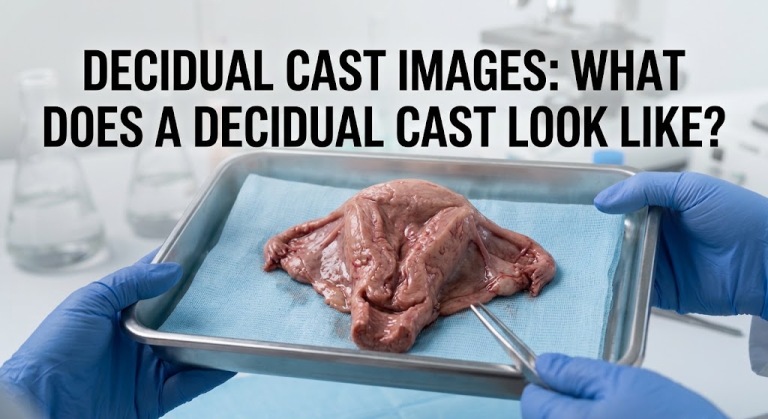
- What a cast looks and feels like
- Symptoms before, during, and after
- Possible causes
- Cast vs. miscarriage vs. clot vs. ectopic tissue
- Warning signs that cannot wait
- What to do in the first hour
- How doctors confirm it
- Pain relief and recovery
- Will it happen again? Fertility questions
- Myths worth dropping
- Frequently asked questions
What a Decidual Cast Period Actually Means
The phrase sounds clinical, but the idea is simple. “Decidual” refers to the decidua, the specialized lining of the uterus that thickens each cycle in case a pregnancy needs a place to settle. “Cast” means a mold, like a plaster cast that keeps the shape of whatever was inside it. Put together, a decidual cast is a mold of the uterine cavity made out of lining tissue.
When people search for a “decidual cast period,” they usually mean one of two situations. Either the cast passed during a bleed that looked like a normal period, or they are trying to understand how the event relates to their monthly cycle. Both are covered here. The key point is that the cast is made of the mother’s own uterine tissue. By definition it is not an embryo, although tissue from a pregnancy can sometimes look similar, which is why testing matters.
It is also worth saying how uncommon this is. Medical literature contains a limited number of documented cases, and nobody has reliable numbers on how often it happens. Many people may pass a cast, assume it was a heavy clot, and never mention it. The rarity is one reason the topic feels so mysterious, and why social media posts about it tend to travel fast.
How a Normal Period Works, and Where a Cast Breaks the Pattern
Every cycle, estrogen builds up the uterine lining. After ovulation, progesterone steadies and ripens it. If no pregnancy occurs, progesterone drops, the lining loosens, and the body releases it gradually over several days as blood, mucus, and small tissue pieces. Enzymes in the uterus help dissolve most of that tissue, which is why ordinary menstrual flow looks liquid or only slightly clotted.
In a decidual cast period, the breakdown step seems to fail or arrive unevenly. Instead of crumbling, the lining stays cohesive and detaches as one sheet. The uterus then has to push out something larger than its usual output, and the contractions that do the pushing can be intense. Think of the difference between sweeping up crumbs and moving a whole rug through a doorway.
Researchers have not pinned down exactly why the lining sometimes holds together. Hormonal swings, particularly involving progesterone, are the leading suspect. We will get into that below.
What a Decidual Cast Looks and Feels Like
Descriptions from patients and clinicians are surprisingly consistent. A cast is typically:
- Triangular or pear-shaped, wider at the top and narrower toward the bottom, echoing the shape of the uterine cavity.
- Pink, red, or grayish-red, sometimes with a pale, fleshy tone.
- Rubbery or leathery, often compared to chicken skin or a thick rubber band, rather than soft and jelly-like like a typical clot.
- Hollow or folded, because it formed along the walls of an empty cavity. If you gently rinse it in clean water, you may notice it opens up like a tiny pouch.
- Variable in size. Some are only a couple of centimeters long, others fill the palm of a hand.
Pass one and the experience is memorable. Many describe the moment of passing as a sudden release, followed by quick relief from the worst cramping. That relief is a useful clue, but it is not proof of anything, so do not treat it as a substitute for an exam.
If you want to compare what you saw with photographs, our guide to decidual cast pictures shows the common appearances, and it also helps to read about period clots versus tissue to understand why they feel different.
Symptoms Before, During, and After
In the days leading up
Not everyone gets a warning. When there is one, it may include light spotting before the main bleed, a heavier-than-normal flow, or pelvic heaviness that builds gradually.
While it passes
- Strong, wave-like cramps, often described as sharper than regular period pain
- Lower back aching or pressure down the thighs
- Nausea, lightheadedness, or a clammy feeling in some people
- A burst of bleeding as the tissue exits
Right afterward
Pain usually eases within minutes to a few hours, and bleeding settles toward a normal pattern. If pain stays severe, keeps escalating, or sits mostly on one side, that is a different story and belongs under the warning signs section further down.
Want a deeper symptom breakdown? Visit our resource on decidual cast symptoms.
Possible Causes of a Decidual Cast
Honest answer first: the exact cause is not known, and in some people no trigger is ever found. Clinicians point to a handful of associations.
1. Progesterone-containing birth control
The best-documented link is with hormonal contraception that relies on progestin, including the progestin-only pill, the contraceptive implant, and the injection. These methods thin or stabilize the lining and can make cycles unpredictable. In some users the lining may build up unevenly and shed as one piece. Reports also exist of casts appearing after someone abruptly stopped hormonal contraception, when hormone levels shifted quickly.
It helps to keep this in proportion. Large health systems note that evidence is limited, and that the possibility of a cast is not by itself a reason to quit a method that works for you. If you suspect your birth control is involved, talk to your prescriber before changing anything. Our page on decidual cast and birth control goes through the options in more detail.
2. Ectopic pregnancy
An ectopic pregnancy implants outside the uterus, most often in a fallopian tube. Even though the embryo is elsewhere, the uterus still responds to pregnancy hormones by thickening its lining. When the pregnancy fails or hormone levels fall, that thickened lining can detach whole. This is the most important cause to rule out because an ectopic pregnancy can become life-threatening if the tube ruptures.
3. Early pregnancy loss
A miscarriage can also produce a cast-like piece of decidual tissue, sometimes alongside the pregnancy sac and sometimes separately. After childbirth or pregnancy loss, hormone shifts can contribute too.
4. Hormonal fluctuations without pregnancy
A sharp rise or fall in progesterone, whether from medication changes, stress on the cycle, or unexplained shifts, may leave the lining thick yet cohesive. Researchers describe this as a plausible mechanism, not a proven one.
5. Unknown or idiopathic
Sometimes the work-up comes back clean. That is frustrating, but it is still a reassuring outcome compared with the alternatives.
For a fuller walkthrough, see what causes a decidual cast.
Decidual Cast vs. Miscarriage vs. Clot vs. Other Tissue
This is the question that keeps people up at night. Tissue from different causes can look alike to the naked eye, which is exactly why a pregnancy test and a medical exam come before any conclusion. Use the table below as a rough orientation only.
| Feature | Decidual cast | Pregnancy loss tissue | Ordinary clot |
|---|---|---|---|
| Texture | Firm, rubbery, leathery | Can be spongy or contain a thin sac | Soft, jelly-like, breaks apart easily |
| Shape | Triangular or uterus-shaped, often hollow | Irregular; may contain a fluid-filled sac | Round or stringy, no defined shape |
| Pregnancy test | Often negative, unless an ectopic pregnancy is present | Usually positive, or recently positive | Negative |
| Pain pattern | Intense cramps, relief once it passes | Cramping and heavy bleeding, may last days | Mild to moderate period pain |
| Who confirms it | Clinician, sometimes via pathology | Clinician with ultrasound and blood tests | Usually no testing needed |
The bottom line: you cannot reliably identify tissue at home. Even experienced clinicians often rely on lab testing. For a closer look at the miscarriage question, read our decidual cast vs. miscarriage comparison.
Warning Signs That Cannot Wait
- Sharp, stabbing pain that is concentrated on one side of the lower abdomen or pelvis
- Pain that does not ease after the tissue passes, or keeps getting worse
- Dizziness, fainting, a racing pulse, pale or clammy skin
- Shoulder-tip pain, which can signal internal bleeding
- Soaking through a pad or more every hour for two hours in a row
- A positive pregnancy test or a chance you could be pregnant, together with any of the above
An ectopic pregnancy is a medical emergency. If something feels wrong, treat it as urgent and let clinicians sort it out. Nobody in an emergency department will think you overreacted. Our page on ectopic pregnancy warning signs lists the pattern in more depth.
What to Do in the First Hour
- Stay as calm as you can. Anxiety is normal, but panic makes it harder to think clearly.
- Check yourself against the warning signs above. If any match, seek emergency care now.
- Take a pregnancy test if you have one at home, and note the result and the date of your last period.
- Save the tissue if you can. Place it in a clean container or sealed bag, refrigerate it, and do not add chemicals. A pathologist can examine it and tell whether it is uterine lining or something else. If you cannot bear to keep it, that is understandable, and a clinician can still help.
- Take a photo beside a coin or ruler for scale. It gives your clinician a reference even if you do not keep the sample.
- Write down the details: when pain began, how heavy the bleeding was, which birth control you use, and any recent changes.
- Call your clinician the same day, or book the soonest appointment available.
How Doctors Confirm a Decidual Cast
There is no single “decidual cast test.” Diagnosis comes from putting several pieces together:
- History and symptoms. Your clinician will ask about cycle patterns, contraception, recent pregnancies, and the timing of pain.
- Pregnancy testing. A urine or blood hCG test checks whether pregnancy is part of the picture. Repeat blood tests may be ordered if results are unclear.
- Pelvic exam and ultrasound. A transvaginal ultrasound looks at the uterine cavity to see whether tissue remains and to look for an ectopic pregnancy, polyps, or fibroids.
- Pathology. If you saved the specimen, a lab can examine it under a microscope and confirm whether it is decidual tissue.
Once pregnancy complications are excluded and the tissue is confirmed, the diagnosis is usually straightforward, and the event is typically viewed as a one-off.
Pain Relief and Recovery
Most of the intense pain happens before and during passage. Afterward, care looks a lot like care for a hard period day.
- Anti-inflammatory pain relievers such as ibuprofen or naproxen can ease cramping if your clinician agrees they are safe for you. Take them with food and follow the label.
- Heat from a heating pad or warm bath relaxes tight uterine muscle.
- Rest and fluids. Bleeding and pain are tiring. Give yourself a day to recover where possible.
- Light movement like a slow walk can help circulation once the worst has passed.
Do not use tampons or menstrual cups if you have been advised to rest your pelvis, and follow your clinician’s guidance on that point. Expect bleeding to taper over several days. If it grows heavier, smells foul, or comes with fever, call your provider because those can indicate infection or retained tissue.
Emotional recovery matters too. Even when the cause is benign, the experience can feel frightening, and some people feel shaken for days. Talking to a friend or counselor is a reasonable part of recovery, not an overreaction. If the tissue was linked to a pregnancy loss, grief is entirely valid.
Will It Happen Again? Fertility and Future Periods
Many clinicians describe a decidual cast as a one-time event, though some people do report repeat episodes, especially if the underlying hormonal trigger stays the same. There is no solid data on exactly how often it recurs.
On fertility, the reassurance is generally good. A cast made of shed lining does not by itself damage the uterus or reduce the ability to conceive. Fertility concerns usually come from the underlying cause, for example a tubal pregnancy that required treatment, not from the cast itself.
If you do not want to conceive, keep using contraception unless your clinician advises otherwise. If a progestin method seems to be the trigger, your provider may suggest switching, adjusting the dose, or watching for a few cycles before making a decision.
When should you follow up after the event? A sensible plan is a visit within a few days, then another check if your next periods are unusually heavy, painful, or irregular.
Myths Worth Dropping
“It always means I lost a baby.”
No. A decidual cast can occur without pregnancy. But because pregnancy tissue can look similar, pregnancy needs to be ruled out rather than assumed away.
“It’s a sign of cancer.”
There is no established link between a single decidual cast and cancer. Persistent abnormal bleeding does deserve evaluation, but that is true for any cycle change.
“I should stop my birth control immediately.”
Not without advice. Stopping abruptly can cause its own hormonal swings and leave you unprotected against pregnancy.
“If it doesn’t hurt now, I don’t need a doctor.”
Relief after passing tissue is common, but a clinician is the only one who can rule out an ectopic pregnancy or retained tissue.
“Only people on birth control get one.”
Hormonal contraception is a recognized association, not a requirement. Casts have been reported in people who use no hormones at all.
Smart Questions to Bring to Your Appointment
- Could this have been pregnancy-related, and what tests will rule that out?
- Should my current contraception be changed?
- Do I need an ultrasound, and is any tissue left behind?
- Can the tissue I saved be sent to pathology?
- What symptoms should make me call you or go to the emergency room before my next visit?
- When should I expect my next normal period?
Frequently Asked Questions
What is a decidual cast period in simple words?
It is a period during which the whole uterine lining comes out in one piece, shaped roughly like the inside of the uterus, instead of the usual smaller fragments and clots.
Is a decidual cast dangerous?
Usually not by itself. The danger lies in conditions that can produce similar tissue, especially ectopic pregnancy, which needs urgent care. That is why a first episode should be evaluated.
How long does a decidual cast take to pass?
Cramping may build over hours or a day and ease quickly once the tissue is out. Bleeding afterward can continue for several days like a normal period.
Can a decidual cast happen without being pregnant?
Yes. Hormonal factors, including contraception, are linked to casts in people who are not pregnant.
What color is a decidual cast?
Most are pink, red, or grayish-red, and look fleshy or leathery. Color alone cannot confirm what the tissue is.
Should I keep the tissue?
If you are able to, yes. Store it in a clean container in the fridge and bring it to your clinician or ask about pathology testing.
Does birth control cause decidual casts?
It has been associated with them, mostly progestin-only methods, but the evidence is limited and hormonal birth control is generally not stopped solely for this reason. Discuss it with your prescriber.
Will a decidual cast affect my ability to get pregnant?
The cast itself is not known to harm fertility. Any impact usually comes from an underlying cause such as an ectopic pregnancy.
Can it happen more than once?
It can, although many people experience it only once. Recurrence is not well studied.
When should I go to the ER?
Seek emergency care for severe one-sided pain, fainting, a rapid heartbeat, extremely heavy bleeding, or any suspected pregnancy together with pain.
The Takeaway
A decidual cast period is one of those body events that sounds terrifying and is, most of the time, not as sinister as it looks. The lining shed whole, the cramps eased, and life continued. Yet the same tissue can sometimes signal pregnancy trouble, which is why the smartest first move is a call to a clinician rather than a guess from a photo.
Keep the tissue if you can, track your symptoms, protect yourself by knowing the emergency signs, and ask questions at your visit. Understanding your cycle is not about expecting the worst; it is about knowing what to do when something unusual shows up. For more calm, plain-English explanations, explore the rest of our library at Decidual Cast.